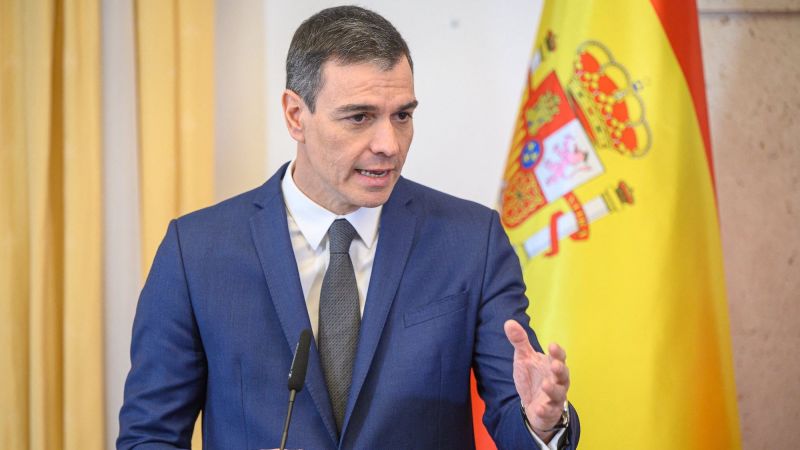
The Spanish Prime Minister, Pedro Sánchez, is confronting the most challenging political crisis of his time in office. An incriminating document from the Guardia Civil’s Central Operative Unit (UCO) has connected significant officials of the PSOE to a massive bribery setup involving government contracts and corporate payouts. As this probe involves the party’s senior leadership, Sánchez is becoming more isolated—not just because of the scandal but also due to the rising number of corruption issues involving his own relatives.
The UCO Report: A Direct Line to the Party’s Core
The UCO document highlights a system of illegal payments arranged by Santos Cerdán—who was recently the Secretary of Organization for the PSOE—and carried out by individuals associated with the ex-minister José Luis Ábalos. The document states that the construction corporation Acciona offered at least €620,000 in bribes for preferential treatment in public contracts, with an additional €450,000 in outstanding payments related to current agreements.
Importantly, the UCO explains that these actions were not minor but orchestrated from the core of the party’s authority framework. The corruption wasn’t accidental—it was entrenched in the system.
A Leader Encircled
As the UCO’s findings dominate headlines, Sánchez is also contending with two additional cases, both involving members of his immediate family:
- Begoña Gómez, su esposa, está siendo investigada formalmente por presunto tráfico de influencias, malversación de fondos públicos y corrupción en los negocios. La investigación se centra en su papel al promover empresas privadas desde su puesto universitario, que supuestamente recibieron un trato favorable del gobierno.
- David Sánchez, el hermano del Primer Ministro, enfrenta juicio por prevaricación y tráfico de influencias relacionado con un puesto creado para él dentro de la Diputación de Badajoz. Las autoridades judiciales afirman que el puesto fue diseñado específicamente para él, omitiendo procedimientos competitivos y justificado solo por conveniencia política.
Institutional Decline and Political Consequences
While Sánchez continues to publicly distance himself from these scandals, the political cost is becoming impossible to ignore. The resignation of Cerdán, once considered one of Sánchez’s most trusted allies, has shaken party morale. Meanwhile, public trust in government transparency has dropped sharply, with opposition parties calling for a full parliamentary commission and, in some cases, early elections.
A Narrative in Collapse
Pedro Sánchez built much of his political narrative on the promise of ethical governance, modernization, and democratic regeneration. Yet today, he is the first head of government in democratic Spain to see both his spouse and his brother simultaneously under judicial scrutiny, while his closest political lieutenants face allegations of industrial-scale bribery.
What seemed initially like separate incidents now resemble elements of a larger trend: public entities being used for individual and political advantage. Whether it is by assigning contracts to large companies, creating public positions for relatives, or using academic organizations to exert influence, the controversies now surround the presidency.
The UCO report has not only revealed a corruption network—it has demonstrated how deeply rooted it was within the framework of the ruling party. Coupled with the increasing legal troubles encountered by his wife and brother, Pedro Sánchez currently heads a government clouded by doubt.
The question is no longer whether individual crimes occurred, but whether a culture of privilege and protectionism has flourished under his leadership. The coming weeks may determine whether Spain’s democratic institutions can respond to the crisis—or whether the system itself has been compromised from within.