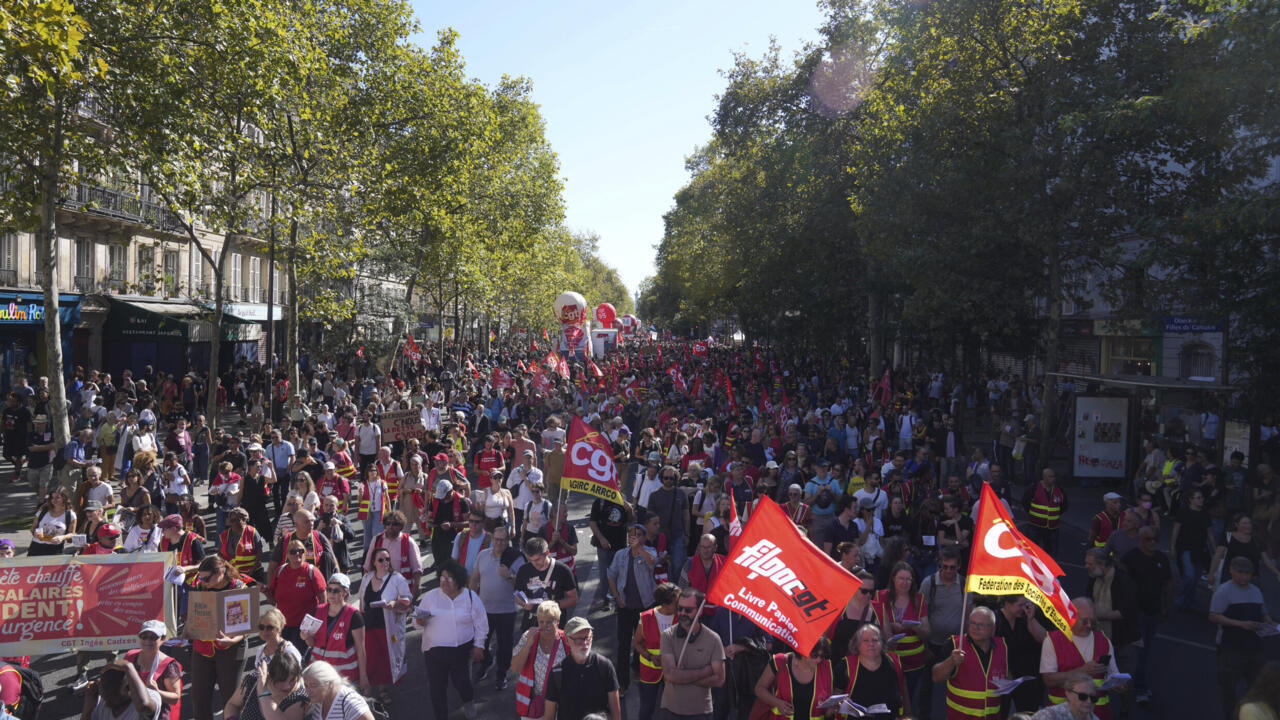
Across France, widespread strikes organized by major unions are sending a strong message against government austerity measures, placing significant pressure on President Emmanuel Macron’s administration. Workers from multiple sectors have taken to the streets, highlighting grievances over pensions, wages, and public spending cuts.
The protests reflect deep-seated frustration with policies perceived to disproportionately affect ordinary citizens while safeguarding economic interests and state finances. Public sector employees, transport workers, teachers, and healthcare professionals have led demonstrations in key cities, including Paris, Lyon, Marseille, and Bordeaux, signaling broad support for the unions’ demands. These strikes coincide with heightened debates about economic inequality, labor rights, and social justice in France.
The origins of the turmoil
The recent wave of industrial action stems from government plans to implement austerity measures aimed at reducing public debt and controlling state spending. Proposed reforms to pension systems, public sector benefits, and social services have sparked widespread discontent. Many unions argue that these measures threaten livelihoods, disproportionately impact lower-income workers, and undermine social protections that have long been hallmarks of the French welfare system.
Economic challenges, such as inflation and the increasing cost of living, have heightened public discontent. Employees believe that austerity measures worsen financial burdens, fostering a climate where strikes and demonstrations are viewed as essential methods to safeguard economic stability. Experts point out that the tradition of labor activism in France is crucial in molding public reactions, as unions utilize strikes as a strong form of negotiation and societal impact.
The administration under Macron has stressed the importance of being fiscally responsible, claiming that changes are crucial for maintaining long-term economic stability. On the other hand, detractors argue that austerity measures may intensify social disparities and diminish public confidence in governmental bodies. The struggle between fiscal caution and social fairness has resulted in a complicated policy environment, making it difficult to reach a consensus both politically and economically.
Extent and consequences of the strikes
The strikes have affected a wide range of services, from public transportation and education to healthcare and municipal operations. Airports, rail networks, and urban transit systems have experienced delays and closures, while hospitals report disruptions in routine care. Schools have faced closures or limited operations, leaving families scrambling for alternatives, and public offices have seen reduced availability, affecting administrative processes.
Beyond logistical disruptions, the strikes carry symbolic weight, demonstrating collective resolve and the unions’ ability to mobilize large segments of the workforce. Protest marches, public speeches, and media campaigns amplify the message, attracting international attention and highlighting domestic dissatisfaction with government policies. Economists warn that prolonged industrial action may have short-term economic consequences, yet unions argue that these measures are necessary to prompt meaningful policy reconsideration.
Political consequences and Macron’s reaction
President Macron must carefully manage the increasing protests. His government needs to address public concerns, engage in discussions with unions, and consider wider economic goals while preserving political authority. If grievances are not addressed, it may weaken public trust, whereas offering compromises could attract criticism from economic consultants and fiscal conservatives who support stringent financial discipline.
Macron’s previous encounters with public protests, such as the Yellow Vest movement, provide context for his approach. The government has historically combined dialogue with selective enforcement measures, aiming to address some concerns without fully abandoning broader reform objectives. In this context, the current strikes are not only a test of labor relations but also a referendum on political leadership and the ability to reconcile fiscal and social priorities.
Union leaders stress that the demonstrations transcend short-term policy changes; they portray the movement as a safeguarding of social unity and entrenched rights. This wider message strikes a chord with citizens who view economic disparity as an ongoing problem, underlining the intersection of labor rights advocacy, civic involvement, and governmental policy. Macron’s management of the scenario might impact domestic sentiment and France’s position within Europe, where economic balance and social unity are under close observation.
Broader social and economic context
The protests are taking place amid worldwide economic instability, increasing inflation, and growing worries about the long-term viability of social welfare systems. People are voicing their dissatisfaction with unchanging salaries, the rising cost of living, and the perceived lack of governmental response to these difficulties. In such a setting, labor movements have become an essential way to express dissatisfaction and push for changes in policy.
Economic experts observe that although austerity could improve governmental budgets, it might also reduce local spending, lower the spirits of public sector workers, and ignite social disorder. Labor strikes and protests act as negotiation tactics and as ways to express community priorities, highlighting the intricate connection between fiscal strategies and public opinion. In France, where labor movements have traditionally influenced laws and societal standards, union involvement still holds a crucial position in affecting policy discussions.
The current mobilization also illustrates generational and regional dynamics. Young workers and students are increasingly participating alongside established unions, bringing renewed energy and visibility to the protests. Regional disparities, including differences in cost of living, employment opportunities, and public service availability, further influence the scope and intensity of demonstrations. These factors collectively amplify the urgency of the strikes and the stakes for the Macron administration.
A challenging period of transition
The result of these strikes will probably hinge on current discussions, the government’s readiness to amend policies, and the unions’ capacity to keep up the pressure. Macron’s government confronts the task of aligning financial reforms with societal expectations, making sure that actions are viable while also addressing public needs. Reaching agreements, effective communication, and prompt actions will be crucial in handling both the immediate disturbances and the future effects on social unity.
For both onlookers and residents, the current developments underscore the lasting impact of unified efforts on molding policy and affecting governance. As France moves through this phase of turmoil, the interaction between economic strategies, workers’ rights, and public opinion will persist in shaping not only the political environment but also the larger conversation about social justice and financial accountability. Resolving these demonstrations will offer important insights into the shifting dynamics of labor relations, governmental policies, and citizen involvement in an swiftly evolving economic setting.